Spooky Season Stories
Last spooky season, we challenged our Editorial Team to come up with bone-chilling short stories that would rattle us to our core—and they did not disappoint. From a delivery gone wrong to an account from the beyond, these tales had us on the edge of our seats.
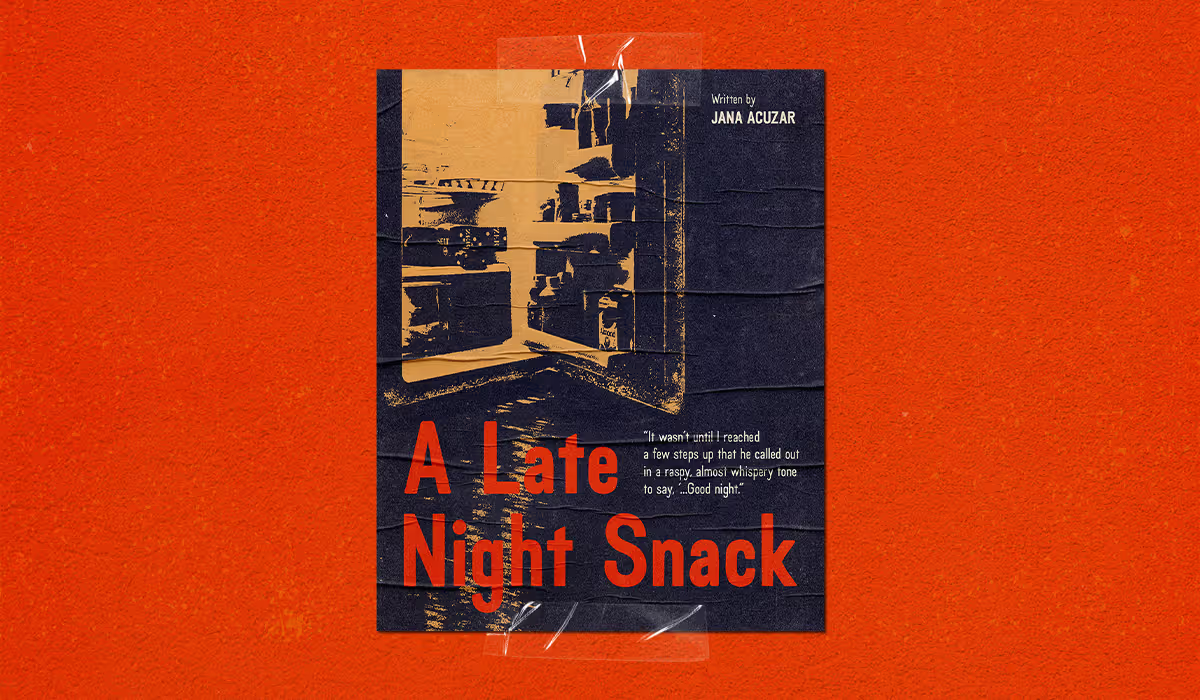
A Late Night Snack
By Jana Acuzar
I found wet footprints in the hallway again. It’s been happening every night for a week now. At first, I thought it was my sister—maybe after a shower or washing her feet—but the prints always went the same way, toward the stairs. Never her room.
I tried to talk to her—sorry, I scolded her—but she kept denying it. Still, knowing that little twerp, she’s probably lying and messing with me. She always does. Tonight, though, I decided to ignore it. I’ve been craving a snack all day, and nothing was going to stop me from raiding the fridge.
So, I headed down the hallway, switched on the stairwell light, and carefully descended. I was nearly halfway down when I heard a chair scrape. I froze—the house was so still I could hear the fridge humming. I squinted into the dark, trying to see what caused it, but the light couldn’t reach past the last three steps. There. I whipped my head right. Something moved—heavy and slow. Who’s there? I zeroed in on its steps, pressing my toes down on the cold, hard tile. It sounds like it’s heading towards the front door. Was it my dad? Could be… usually, he would be up at ungodly hours to smoke or watch the History Channel. I felt my shoulders go a little limp...yeah, probably just my dad.
When I heard him walk far enough, I carefully made the rest of the way down. Once I reached the bottom, I gripped the railing and peered towards the front door, ready to meet my dad’s eyes or the back of his head, but then I saw… no one. The room was completely empty. I checked the door—still locked. I didn’t even hear it open or close.
“Pa?” I called, trying to make my voice sound even.
No answer.
He must have gone in a different direction than I thought. There was another door to the far right, just a few steps across the living room. That was my parents’ room. One of them must have gotten up for a quick drink. I brushed it off and headed straight for the fridge. I was met with a bright light, and the cold air pricked my skin as I grabbed a few bars of chocolate along with a chilled tumbler that I’d left in this morning.
Finally, I was going to enjoy my treats. But just as I turned to head back towards the stairs, I saw my dad standing by the front door. I immediately felt a wave of relief when I realized it was him.
“Oh, you’re up! I thought I heard you.” I said as I closed the fridge.
It’s a bit dark by the door, and I couldn’t make out his expression.
“There’s still some left if you want”, I said, thinking he might be hungry. He simply nodded.
He looked grumpy—as usual— but also… damp? I turned to place my tumbler on the counter, as I tore a wrapper in half.
“Did you use the upstairs toilet today? The floor’s wet.”
No answer.
“...well, if you did, remember to mop please?”
I heard what sounded like a faint grunt before he grabbed a chair to sit. He must have been tired and wasn’t up for conversation. I shrugged it off, swiftly made my way towards him, and gave him a quick hug. He turned slightly to look at me. I remember seeing how red his eyes were, he looked fatigued, and his lips were chapped.
“You okay?” I asked.
Looks like he woke up from his sleep. Thinking he might not be up to talk, I awkwardly peeled myself away before telling him good night. It wasn’t until I reached a few steps up that he called out in a raspy, almost whispery tone to say, “...Good night.”
Once inside, I locked my door and unpaused an episode of “The Office”. I stayed up until 2 AM that night watching my show and enjoying my snacks, forgetting all about the hallway, the footprints, and the weird noises downstairs.
The next day, my mom and I were in the kitchen together. She was sitting at the dinner table working on her lesson plan, and I was cooking lunch. She was talking about a video she saw on Facebook, but I hardly paid any attention, remembering those wet footprints in the hallway again.
“Ma, have you been using the upstairs bathroom?” I asked. She paused mid-sentence and asked me to repeat myself, “Have you been using the bathroom? The hallway keeps getting wet.”
She sighed and told me, “No, I haven’t gone upstairs since. It must have been Maya.”
I was stirring the soup as I replied, “No, she said it’s not her. Maybe it was Papa, he was up late last night, too. Is there something wrong with the downstairs bathroom?”
She didn’t answer.
“Ma?” I turned my head slightly, peering over my shoulder, “...is there something wrong with the bathroom? You know, it’s fine if you guys need to, but could you mop the floor at least?”
I thought she was scrolling through her phone when I turned to face her, but when I did, all I saw was this confused look on her face…like I had done something wrong. I stared back at her, chuckled even at her weird pause. I tried asking her again if she or dad had anything to do with the annoying prints, but she hit me with something else...something that made my blood run cold…
“What are you on about? He’s working in Siquijor. He left a week ago and won’t be back until this Saturday.”
The room went still. Did I hear that right?
“What?”
She looked up from her phone and said, “Your dad–he left a week ago.”
What? I felt like I would vomit, my fingers throbbed, I felt like I swallowed my tongue, the cold, cement floor pushing hard against my feet.
“But we were just talking… last night, he was sitting right there,” I tried to convince her, to convince… myself.
She pushed herself off the table and asked me what I hoped to God was some kind of sick joke, what I hoped was just a chocolate-induced dream, what I hoped wasn’t the reason my gut twisted the way it did when I reached those last few steps: “...who were you talking to?”
Choke
By Julia Benito

Music blaring through headphones, blue light radiating from screens, the tension beneath her fingertips after every frantic clack, clack, clack of her keyboard—signs of another sleepless night for Angelica, who, as evidenced by the dark, purple splotches under her sunken, half-glazed eyes, had unwittingly reached a delirious state of flow. Her phone alarm had been going off for the past three hours, pleading for her to go to bed, but she ignored it.
Not now, she thought. Not when her career was on the line.
She’d been at it for hours, poring over data and analyzing every angle she could, trying to make sense of why she hadn’t been hitting her sales targets for her third month in a row.
Oh, she could get fired for this. No, she’d definitely get fired for this.
But then again, would that honestly be so bad? Would starting fresh, away from all the numbers, really be the worst thing in the world? Could she give up her goals of climbing the corporate ladder to do… well, literally anything else—barista, boulderer, pottery teacher? Surely, there would be something out there for her that didn’t make her feel like vomiting her guts out from anxiety every morning.
But as she sat there, torn between focusing on her work and daydreaming about a life she’d only seen on TikTok, outside, in the dark, something sinister was creeping through the city—not quite a creature or a ghost, but a void: the deep, sinking feeling of absence made mobile, leaving behind an inexplicable dread and a metallic chill in its wake.
The entity seeped through the cracks in the window, as subtle as a cold night’s breeze. But this breeze was not gentle. It didn’t caress Anj’s skin; it scorched a path into her throat before plunging, a jolt of pure malice, straight into her lungs.
Anj’s chest heaved, choked gasps escaping her lips. She clawed at her throat, desperate for air.
And then she was still.
When the sunlight streamed in and her alarm went off, Anj woke up as she normally did—eyes fluttering open as she yawned and stretched from head to toe atop her bed. But as she looked frantically from the billowing fabric of her curtains to the tufts of her carpet and the stains on her ceiling, she realized she hadn’t moved at all.
She tried tilting her head or moving her hands in front of her, but her muscles were frozen still. She couldn’t possibly be asleep, could she? It all looked so real—no, it was real. She could even hear Summer, her roommate, making her godawful green smoothies in the kitchen.
Sleep paralysis—she had heard horror stories from others, but it never happened to her. That was, until now. Until she found herself screaming inside her own body, muscles straining as they fought to move limbs that had locked in place.
And then she did move. Her legs swung over the bed, head rolling from side to side.
Anj blinked. She was moving, yes, but she wasn’t moving… was she? In her mind, she flexed her fingers, but through her eyes…
“It’s okay,” said her voice, but not her voice. “Just sit and watch.”
…What? Anj couldn’t breathe, as if suffocated by her own body. It felt like she was banging on one-way glass as she watched Not Her make its way into the bathroom to assess itself in the mirror.
“You’re not so bad, huh?” Not Her said, grinning. “I kinda like you.”
Whatever you are, get OUT of me RIGHT NOW! Anj screamed within herself, fists beating against the inside of her chest. Like that did anything.
“What do you mean? I’m you, obviously.” That shiteating grin again. “I mean, not fully. Not yet. But I will be. And I’ll be even better—the you that you wanted.”
I like myself just fine, Anj replied in defiance. Leave me alone.
Not Her tapped its head and winked. “Not what you’re saying in here. Don’t worry; I’ll fix it.”
Everything that followed happened so fast.
The knife. The blood. The green sludge of whatever vegetables Summer was desecrating, now dripping out of the cracked blender.
Not Her didn’t even care that it wasn’t wearing slippers. It just stepped through it all, reaching Summer’s fresh corpse to stroke her blonde hair. The blood on its hands stained Summer’s perfect, beachy waves. “What’s with the theatrics? Don’t act like you didn’t hate her.”
Anj’s mouth hung open, tears streaming down her face. Are you insane?! I never wanted her DEAD!
“Really? You sure about that? Because I have receipts.” Not Her coughed, taking on a mocking, high-pitched voice. “And I quote, ’Sometimes, she talks so effing much I want to drive a pen in her eye. I wish she’d shut up and drop dead.’ That’s something you thought. Am I wrong?”
Anj stammered. No! Yes, but… But I… I didn’t… That wasn’t…
“Oh, but it was. And you know what else? That job you hate?”
Stop it. Please, stop it.
“But you wanted this!” Not Her laughed, sliding the phone out of its pocket. It dialed her boss’s number. “Hey! So, I… what? No, sir, I’m not on the way to work yet. Actually, I don’t think I’m coming in today. Or tomorrow. Or ever. Why? Are you serious? You’re company is a sham. You pocket any kind of profit you can get your hands on while paying your employees crumbs. You’re a joke and a liar who can’t make an original thought, yet has the audacity to take credit for everyone else’s work. On top of that, you sleep with your secretary in your office—don’t act surprised; literally everyone knows. Then, you go home to your wife and kids and act like you’re doing them a service when your wife has literally gone into the office with a black eye. Really? You want me to keep working for you? Get real.”
Anj watched it all through a body that should’ve been hers, but wasn’t—even killed with hands she no longer owned. Through it all, she had fallen to her knees, tears falling one after the other, soft sobs breaking the silence in her mind.
If she ever made it out of this, no one would believe her. Her clothes were stained with blood. Her prints were on everything. There was nothing to suggest that a third person had broken into her apartment. All they would find is her.
As meaningless as her job seemed now, she knew she could never work in that industry again. Her boss schmoozed with a lot of big people—people who wouldn’t want a nosy brat telling everyone they’re abusers.
“Oh, wait,” Not Her started, tapping a bloodied finger against its chin. “I think I have one more phone call to make.”
Anj watched Not Her tap into her contacts—her favorites. She knew there was only one.
Her boyfriend, Dan.
“You never did forgive him for that fight when your parents died, did you?”
DON’T YOU DARE TOUCH HIM! Anj screamed, hysterically pounding against her mind. Don’t do this. Please don’t do this. You can’t do this!
“Oh, but I can. I’m you, remember?”
Stop it, Anj croaked, sliding down against the darkness behind her, voice weak and mind spinning. Please stop it. I’ll do anything.
“But you’re already doing it!” Not Her laughed again—melodic, practically giddy.
Not Her pressed Dan’s name on her phone.
It rang thrice.
“Hey, can you come over?”
Instructions for a Funeral
By Jed Daya

The last gift was the sudden, almost satisfying snapping of the hips—right down the middle where the pelvic girdle met the humerus which met the femur which met the patella. The area splintered into a thousand pieces, some shooting out of his sides, briefly illuminating the inky, inappropriate darkness of the curb, others clinging to the fibrous knots of tissue and muscle fiber. He was thrown clear, they would say later—if they ever found him—but he felt only the grit of his shoulder pressed against his cheek, an indifferent, geological cold lit by a wave of crimson.
Before rigor set in, he recalled two voices—maybe three. He figured that, at the very least, he would try to gather as much information about them for the police report. But the distinctiveness of pitch and tone that had once compelled us to give things names was replaced by a monotonous hum, like a fog attempting to rise to the surface. He heard bits and pieces—the road was slippery, the brakes were heavy, the streetlamp had suddenly gone out. Soon the ramblings gave way to clarity. He was thinking about the arrangement of things: the keys on the hook, the damp towel on the rack, the necessary clutter he would return to. All of it depended on a certain velocity, a momentum he no longer possessed. In a last, desperate effort, he twisted his arms away from their shoulders, causing them to drop him. A fistful of dirt entered his mouth as the asphalt gave way to damp, rich soil. The larger figure gestured toward him, and the hazy bulbs of its eyes locked onto his, freezing him in place. He cocked his head, trying to find direction. Out of the corner of his eye, a yellow flicker, methodical and distant. His arms dug into the earth, propelling him toward the light, as though what remained of his legs had migrated into his upper arms. He grasped the edge of the road when a dark slab descended onto his wrist—the force strong enough to rupture his vessels but blunt enough to leave the tendons intact. He rolled onto his back, bracing for the next strike. In the brief moonlight, he caught a glimpse of a phrase spelled in bold, black ink across the figure’s scrawny forearm—love coquers all. His brows furrowed; he lowered his hand to catch another look, only to be interrupted by the swift and sharp intrusion of a rock right down the middle of his skull.
He had hoped for heaven but prepared himself for punishment, so long as it wasn’t eternal. What he hadn’t expected was to be half-buried just ten feet from where he’d died. At first, he wasn’t sure he was dead. Maybe paralyzed, he thought—which made him panic, which made his heart race, except nothing thumped in his chest. No breath entered his lungs. It wasn’t until he realized that, unlike the night before, he could feel his legs. Not sensation, exactly, but awareness—of what had been broken off, which way it bent, and where it was now: a few meters north of him, a little left of what was left of his right hand, haphazardly sawed off. Soon, autolysis set in. The structures that had once held intention began to fail from a lack of oxygen, producing a burning, acidic environment. This acid was not painful. It felt like overwhelming, intimate regret—the self turning against its own architecture. The muscles stiffened, locking his limbs in a position neither rest nor flight. Rigor mortis. The memory of walking, of the easy lift of a foot, felt obscene beside this new fixed imprisonment. The skin, a thin white glove, began to lift from deeper tissues, forming bubbles of glossy tension. Perhaps this was punishment. Perhaps, in life, he had unknowingly tipped the scales toward sloth, and now was condemned to immobility, forced to reconcile where things went wrong. But before any penance could be made, a pack of stray dogs entered his field of view. Their legs were hairless, rugged; their chests embossed with ribs. Their wild eyes grew wilder as their snouts confirmed the search for a meal was over. Soon, the pack scouted the area, plastering their noses to the dirt that held pieces of his body.
He anticipated pain, though he had already confirmed his passing. Yet the incessant gnawing of his innards felt, ironically, like passing gas. He felt himself grow lighter—as if being eaten was his ticket to the great beyond. His daydreaming of the afterlife was interrupted by a snarl. The scrawniest of the bunch had found his femur, clamped lopsided in its mouth. Before it stood the largest canine, sneering, scarred ears pointed and unmoving. Seconds passed. The smaller one twitched left, attempting to flee. But before its hind legs could push from the ground, the larger jaw lifted its neck skyward. The noon sun flashed off white fur before the larger one slammed it back into the dirt, shaking its head so violently that for a moment they became a blur of black, white, and red. When the pack had licked clean what they could find of him, and the smallest pup had taken its final breath, he witnessed the sky open up—a shaft of light embracing the dog’s body. Wisps of smoke enveloped its fur before a violent, piercing shrill tore through the air. A translucent, almost luminescent afterimage appeared before him—its coat whiter, thicker; its body now full, well-fed. Its eyes met his before it tilted upward and shot into the sky. The light faded. Silence resumed.
The pressure became his new reality. It started deep in the abdomen and spread—a slow, inescapable inflation caused by the accumulation of gases. A physical paranoia. A crushing volume generated by his own private, chemical ruin. No one was there to witness it, yet he felt perpetually observed, judged by the grotesque extent of his expansion. The color followed the pressure: a deep, sickly green blooming beneath his skin, the tint of decomposing blood, destroying the clarity of his memory. He tried to recall the sky’s shade that dawn—a clean, pale blue—but the memory was now corrupted, smeared by a sweet, sulfurous density. Then, a low, insistent hum settling on the exposed tissue. Calliphoridae. Blow flies. He did not find them frightening, only necessary—tiny workers drawn to the scent that announced failure. As they moved across what remained of him, he wondered: do dogs sin? Were they bound by moral code? Perhaps their rules weren’t as strict, and thus the mutt had repented in record time. What, then, was unforgivable? That wasn’t it. He had sensed something in the dog’s eyes—something present, whole.
The fly larvae hatched and began their work. They felt like a soft, writhing layer consuming tissue with efficiency both terrifying and logical. This was the economy of yielding—the energy of his spent life transferred instantly into another cycle. Then came more teeth: the quick, purposeful scrape of rodents on small bones and joints. Their gnawing was precise, almost clerical, treating the wrist and ankle as obstacles to the nutrient beneath. It was the final, devastating loss of arrangement. The parts that once constituted him now scattered, each piece divorced from intention, left to suffer its quiet fate on the cold ground. He felt lighter, but foggier. Moments of clarity grew fewer, replaced by a humdrum of meandering consciousness. Maybe what he lacked wasn’t spiritual nor moral, but physical. What the dog had wasn’t moral superiority—it was simply everything in the right place.
Before he could chase this thought, the hum returned—followed by a yellow, flickering beat. He could make out the face now: close-cropped hair, thick brows, a round face, gaunt yet broad-shouldered. Perhaps I can tell my story through séance, he thought. Despite himself, he felt no rage, only curiosity—remorse, even. The figure took out a spade and began digging a hole. With calculated precision, he gathered the disparate parts of his body—now only the barest facets of what was once life—and arranged them at the bottom. The figure paused, carefully placing slick bones into the pit. A bizarre, desperate devotion, as if to reverse the great scattering that nature had just achieved. He knelt, lips moving in a silent prayer over the pile of calcium and dirt. But before the final arrangement could be completed, the rain began—not a shower, but a cold, heavy insistence that overwhelmed the lip of the shallow grave. The earth, saturated and yielding, could not hold its form. The dark, viscous material he had become flowed, and the bones were lifted, dispersed again by the cold logic of gravity and water.
He was carried—a collection of clean, cold remnants—through the dirt, pulled downhill by the runoff until his fragments reached the muddy edge of a small, indifferent lake. He was structurally ruined, his geometry destroyed by the very thing—water—that had once sustained him. As the clouds parted and soft light filtered through the firmament, he began to sense the distance his parts now covered. His upper body—the anchor of consciousness—remained mostly intact, yet his extremities were indistinguishable from the soil. A finger here, a clavicle there, an ankle ten meters away. He felt like an ant colony: tendrils of some unknowable force humming, churning, zigzagging across the ground. This awareness made him realize his torso perched precariously atop a cliff—a cliff standing proud against the vast lake.
The sight of water brought relief; he hadn’t seen anything beyond the browns and greys that filled his days. As he basked in what he imagined was fresh air, he felt it—a breeze. Impossible, he thought. He had spent countless days yearning for that cool touch, left in the dust. But this time, he saw the air drifting above the surface of the water—like steam from a porcelain cup. He inched closer, desperate for what might elude him again, but closer inspection revealed the truth. What rose from the lake was not air, nor steam, but strands of primordial ooze—the same stuff that made him and everything else. The lake’s surface was a writhing amalgamation of limb and bone, twisting toward the sky only to fall short and collapse again, reforming anew. The outer layer, ghastly innards circling to create form; within, unmistakable human faces—men, women, children, the old, the colonizer and the colonized—all with mouths agape and empty sockets aimed at the sun. It was as though he’d split open the trunk of existence itself and glimpsed every life that had ever walked this little rock.
Through this awe and anguish, he saw what awaited beyond: cold, smooth, white structure—the final, silent proof. Consciousness persisted, bound now to the rigidity of stone, registering only the slow, indifferent physics of the world. The microbial respiration slowed, leaving only the deep cold of mineral memory. After a thousand years, the bone ceased to be his own. Porous now, its essence replaced by the soil’s silica and iron, he entered a cold barter with time. The stone was not inanimate—it was witness. The calcium of his former self absorbed into the indifferent crust. No longer structure, but particle. The stone he occupied—a fragment of basalt, perhaps—had been rolled smooth by water and sand, reshaped by erosion’s quiet persistence.
Because of its strange geometry—the curve of a rib, the density of a joint—it had been handled by many through the ages. Buried with one man until a tree devoured its grave and drew it back to the surface. Later kept by a woman who revered it as a household spirit, filling its sockets with jasmine and grass. Every thousand years, his consciousness registered new patterns of life touching the coldness of his remains. His brief existence—the hit-and-run, the fear, the shame—was now merely a thin layer of sediment.
He then felt movement, a tug, an embrace. And then—a thud. He had been dumped into a mound of dirt. His body, broken down and weathered, was now indistinguishable from the earth itself. Yet he still felt a tenuous connection between the things that once made him whole. His consciousness spread in a labyrinthine mess—not out there, but everywhere. Around him, more sacks of dirt filled the space.
Then—a change in the light. A clean, brilliant flare erupted overhead, cutting through the damp dark of early morning. It was impossibly bright, a pure vertical light, and in that sudden, painful illumination, he felt wholeness. His scattered pieces seemed to snap back into their intended configuration, a flicker of restored identity. This is it, he thought—the ascent, the grace he’d denied himself. But the light stayed on, warm yet unmoving, humming with the cold, electrical competence it had lacked hours before, restoring order to the violence of the curb. It cast a mechanical, yellow flicker that illuminated the asphalt.
No Video, No Refund
By Lyn Higwit

Ding.
The familiar sound flows through her apartment and to her warm bed, gently rousing her from sleep. The clock stares back at her, bright digits almost blinding—but she must be sleepier than she thinks because she swears it reads 3:00.
Her phone is in her hand before she processes her surroundings, and she goes through the motions. It’s practiced: She looks for any calls or messages alerting her. She scrolls and taps away.
Shipped out.
Ad.
Reel.
Ad.
Sigh.
Ad.
But none are of packages or visitors.
The temperature drops.
She pulls the blanket over her face. Against her better judgment, she thinks nothing of it. Probably nothing, her sleep-deprived mind supplies. After all, people always tell her to get the wiring checked. “That’s not normal,” they say.
And to that, she says: “There’s always tomorrow.”
_________________________
Ding.
Another chime announces its presence—it tiptoes through the doors and past the rooms, until the sound settles in her bed. It’s short and polite. Almost patient, as it waits to wake her up from her slumber.
She moves quicker this time around. With her phone in hand, screen blooming to life when she lifts it: 2:00.
No alerts, no missed calls from the lobby—only the dim, slow scroll of midnight diluted by muted videos, unread messages, ads she’s already seen.
Parcel has departed from sorting facility.
She lowers the phone—mind listening to the quiet, vision adjusting to the darkness. Has her room always been this big? It feels so vast, suddenly, with walls giving her bed too wide a berth. The air-con hums from a distance, the monotonous drone a grounding noise to her senses.
Discomfort and unease lurk in the air as she stares at the ceiling, waiting for it to come again. It doesn’t. Still, the image of a single light in the hallway flashes in her mind—flickering faintly, persistently, behind the door.
She’s being silly, she knows. She tells herself it’s nothing: faulty wiring or a loose contact, as the maintenance staff say—something ordinary. Yet, she waits.
And waits—because the moment her eyes close, she hears that note hanging in the dark: flat and steady; a sound not meant for her.
Waits, until fatigue and dread consume her.
Her deep, steady breathing meets dead quiet, syncing with the machine’s exhausted groans. The fridge forms a cadence, using her soft inhales and exhales as its metronome, shaping a chorus of rhythmic murmurs.
A sharp noise resonates, cutting through that stillness—
Ding.
_________________________
It wakes her before it makes its presence known.
Tonight’s air feels wrong—too still, too careful. The router’s blinking glow dims, replaced by a single pulse from the clock that reads “1:00.”
She waits for it.
Ding.
Then again.
Ding.
Ding.
Three notes this time—measured, deliberate.
Insistent.
She sits up, her heart hammering inside her ribs. Echoing the same beat—a staccato so sharp it’s biting.
She drags her leadened feet against the floor, her steps holding neither weight nor sound. The chime doesn’t fade; it persists. The walls carry it from wall to wall, room to room.
The room closes in. The noises that live in the apartment are gone. The air-con hum anchoring the silence, gone. The fridge, too. Everything waits with her.
She reaches the door and steadies a hand against it. Cold. It’s her palm that leaves warmth behind.
Her phone screen stays black when she wakes it. No signal. No time. Only her reflection, gray and small in the glass.
Ding.
It comes from somewhere deeper than the door now—beneath the floor, behind the wiring, from the space she occupies. This time, it listens back.
She backs away until the bed touches her knees.
The quiet follows.
It’s shrill in her ears—deafening.
_________________________
Morning never feels real after that.
She spends the morning pretending the night didn’t happen—the past is just a memory.
The lights come back on; the air vibrates with noise again. Normal, she tells herself. Everything sounds exactly as it should.
She scrolls through delivery apps while coffee drips into the pot. No new messages. No missed calls.
Parcel is out for delivery.
She lets the screen die down. Her face reflects on the glass, tired and grainy.
By afternoon, she unplugs the intercom. The silence that follows is supposed to be comforting.
15:00.
18:00.
The hours slip by faster than they should, as if the day wants her gone.
20:00. 20:30.
She props her phone against a mug, camera facing the door.
_________________________
When the door chime rang that one night, she should’ve known better.
She hadn’t waited for it—she’d been ready. The phone was already plugged in and open, camera angled toward the door. Proof for tomorrow, she thought. Evidence for the maintenance or electrician.
The words sounded smaller out loud.
The clock blinked twelve. Midnight.
Ding.
The line of light under the door trembled, then steadied. On-screen, nothing had moved except her breathing. She waited for the second tone.
It came later than expected, softer. Tentative.
Another pulse of light.
Ding.
Everything was in its place.
Then the tone rang.
Under her. Behind her. Both near and far away.
The camera stuttered.
For a beat there were two of herself: one holding the phone, one frozen by the door.
Playback time crawled upward—
00:01, 00:02.
Ding.
A single notification popped up.
Parcel has been delivered.
They found her phone—screen cracked and battery long dead. And when it powered on, the latest photo in her reel greeted them: an empty room and an open door.